

Academic Impact
The AI Future of Rehab Counseling
When students in the Clinical Rehabilitation Counseling program of Auburn’s College of Education walk into class these days, they’re just as likely to open an AI interface as they are a traditional resource workbook.
In their courses, AI isn’t a shortcut or novelty. It’s something students must question, compare and ethically assess. Guided by Meyer and Park, students test their own reasoning against AI-generated recommendations, probe chatbot outputs for accuracy and explore labor market data pulled in seconds rather than hours. The result is a program that moves beyond traditional instruction and becomes a training ground for the future of rehabilitation counseling.
“We’ve integrated AI into counselor education courses within the Clinical Rehab Counseling Program,” said Meyer, director of Counselor Education and Forensic Rehabilitation. “The integration has been so helpful.”
Teaching the future of practice
In spring 2025, Meyer, Park and Matthew McClanahan, one of the forensic experts for the rehabilitation programs, introduced generative AI into two specialty courses, Vocational Evaluation and Occupational Career and Placement Services, giving students hands-on experience with new tools while they learned foundational counseling skills. The work is funded by the Rehabilitation Services Administration (RSA) Innovative Rehabilitation Grant – No. H263F200004 (2020-2026)
“A lot of the work that we do in rehabilitation counseling is very applied,” Meyer said. “The skills students develop in the program are tools they will use with clients.”
Students in the Clinical Rehabilitation Counseling Program, which is ranked No. 13 nationally by U.S. News & World Report, now use platforms such as ChatGPT, Perplexity, Claude, Gemini, and Microsoft Copilot to build vocational profiles, interpret assessment results, analyze labor market data and compare their professional judgment with AI-generated recommendations.
McClanahan first used the approach in his spring course, which was the pilot for the rehabilitation counseling programs. Park then expanded the model in her summer course, requiring students to conduct a labor market survey with AI tools using the same case scenario. Students were pushed further, using prompts to gather information on accommodations, wages, job openings and labor market trends for those with disabilities.
“Students evaluate how such information is helpful, accurate and useful,” Park said.
The why behind AI
Park notes that this work is not simply instructional innovation; it responds directly to rapid societal change.
“It is obvious that Artificial Intelligence is changing how people search for jobs, how workplaces operate and which skills matter in the labor market,” she emphasized. “These changes are already shaping career paths, workplace expectations and access to employment. For people with disabilities, AI introduces both opportunity and risk.”
Her concerns reflect national trends. The U.S. Department of Education highlighted in 2024 that responsible use of AI can expand access to competitive, integrated employment, especially through accommodations, remote work, universal design and assistive technologies. But the department also warned that poorly designed or unregulated AI systems can reinforce bias, limit accessibility or create new barriers.
“To address the dramatic changes driven by evolving technologies, including AI, both rehabilitation counselors and individuals with disabilities need to be prepared,” Park said. She notes that federal guidance now recommends that vocational rehabilitation programs support AI literacy and training for people with disabilities and use AI responsibly within vocational rehabilitation service delivery itself.
“These emphases closely align with the mission of our profession: empowering individuals, removing barriers and expanding access to meaningful work,” she said.

Ethics at the core
With new tools come new responsibilities. The Counselor Education programs adopted a formal AI use policy in fall 2024.
“A big piece of using AI is being ethically responsible,” Meyer explained. “We can’t just hand over the tools. We have to train students on ethical considerations, especially understanding and evaluating the output.”
The latest efforts at Auburn are already generating new scholarship. Meyer, Park, McClanahan and Asim Ali, executive director of Auburn’s Biggio Center for the Enhancement of Teaching and Learning and a College of Education alumnus, along with doctoral students Danny Dore and Alexis Dowdell are analyzing student prompts, reflections and AI outputs to identify where human and AI recommendations align or diverge. A second study will include national focus groups with practicing vocational rehabilitation counselors exploring the real-world benefits, risks and ethical concerns of AI use.
A new WebVR module, designed with Auburn’s Biggio Center, will add an immersive component to Auburn’s curriculum by giving students a virtual environment to explore AI-enabled vocational tasks.
“We will have something visual in time to launch for the summer,” Meyer noted, with more details forthcoming.
The work of Meyer, Park, McClanahan and Ali has also gained wide recognition, with them delivering their second national presentation on integrating AI into Counselor Education-Rehabilitation Counseling in March at the American Board of Vocational Expert’s annual conference in Santa Fe, New Mexico. The group presented on the topic of “Integrating AI into Vocational Evaluation: Applications for Education and Practice.”

AI in the field
Auburn’s forward-leaning approach is already resonating with such alumni as Isaac Beavers, a 2013 graduate and executive director of the Alabama Freedom Center for the Blind. Returning for certificate coursework reintroduced him to a wide range of AI tools.
Exploring AI tools such as Microsoft Copilot and Google Gemini “was great for me,” he said, noting his preference for Gemini’s “less cluttered” interface.
Beavers now uses AI daily to support career exploration for blind adults, where traditional resources like the Dictionary of Occupational Titles lag behind today’s labor market.
“AI helps give you better, up-to-date labor market information,” said Beavers, the College of Education’s Special Education, Rehabilitation, and Counseling Alumni of the Year award winner for 2024.
Advising a client interested in becoming a disc jockey, he found AI helpful in clarifying that podcasting, not traditional DJ work, now represents the larger share of opportunities. He also uses AI as “a more advanced spell check and grammar check” in professional writing.
Still, he stressed a limitation no technology can cross: “You can’t generate genuine, warm, positive regard. You can’t generate empathy.”
“AI is a tool, not a replacement,” Meyer echoed.
Teaching with AI
McClanahan, another Auburn alumnus and adjunct faculty member, has become a key partner in integrating AI into vocational evaluation coursework. In his forensic rehabilitation practice, he uses AI, after carefully redacting personal data, to produce rapid, relevant analyses. He also uses chatbots to simulate deposition questioning, giving students a rare preview of real forensic work.
His partnership with the Biggio Center also led to a course-specific chatbot built by Ali to help students navigate definitions, modules and deadlines.
Across the Clinical Rehabilitation Counseling programs, the message is clear: AI will reshape the work of rehabilitation professionals, but it will not replace them.
“AI shouldn’t replace us,” McClanahan said. “It should supplement us and make work more efficient or more accurate.”
With thousands of vocational rehabilitation positions open nationwide, Meyer and Park believe Auburn graduates, grounded in ethics, trained in applied skills and fluent in emerging technologies, will enter the field ready for the future.
“The rehabilitation counseling field must support current and future professionals, promote responsible and accessible innovation and partner with disability communities,” Park said. “We must make sure that AI strengthens employment opportunities for all.”

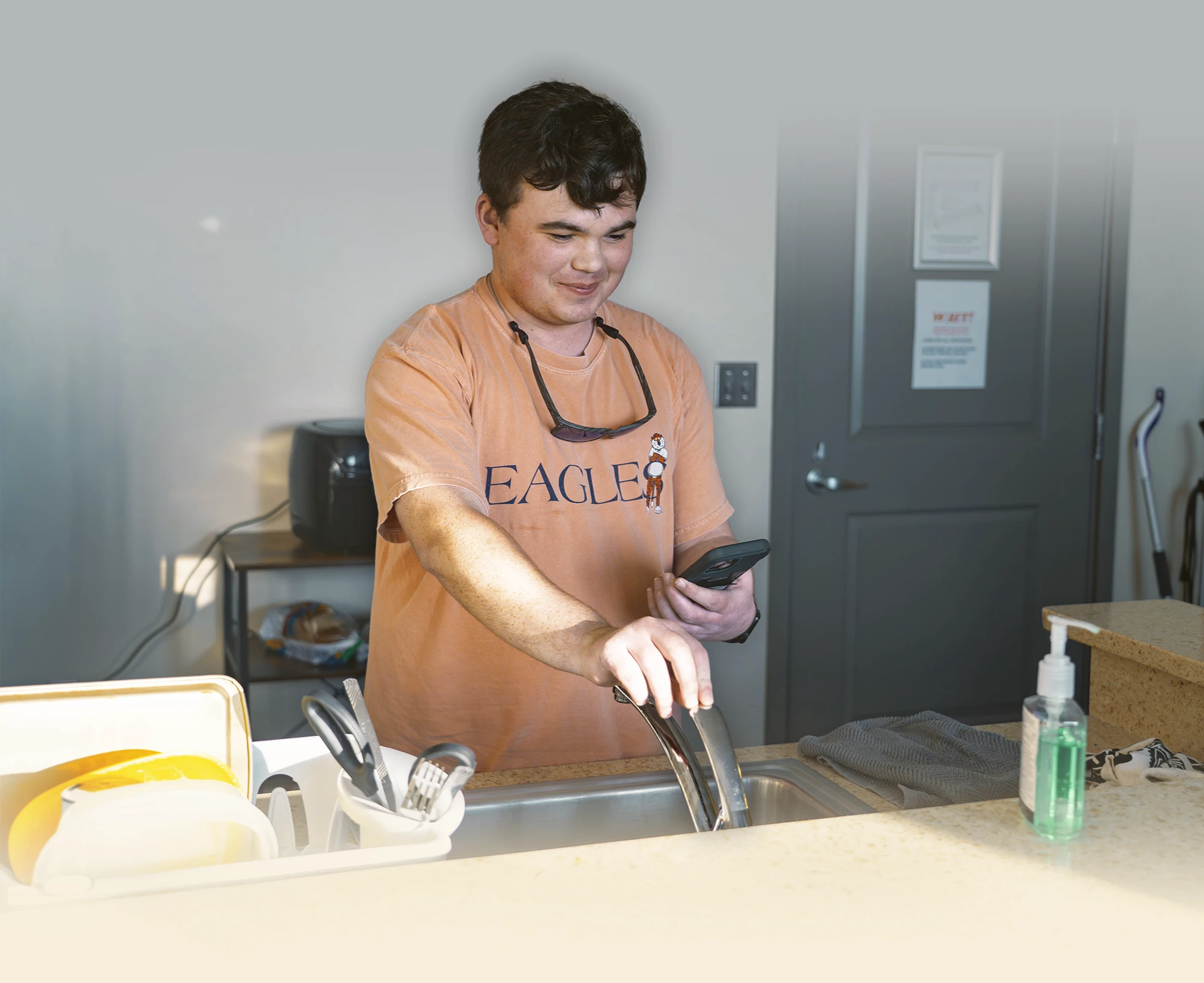
AI as an Equalizer
rtificial intelligence might sometimes be viewed as a tool for efficiency, but for students with intellectual disabilities, it can be so much more. Some might even say it’s an equalizer.
EAGLES (Education to Accomplish Growth in Life Experiences for Success) is a comprehensive transition program in Auburn’s College of Education for students with intellectual disabilities. From academics and wellness to independent living and career readiness, the EAGLES Program empowers students to thrive. As part of that effort, the program is proving that when technology is taught responsibly, it doesn’t just streamline tasks, it opens doors.