
Advancing Innovation & Outreach
Tools for Teachers
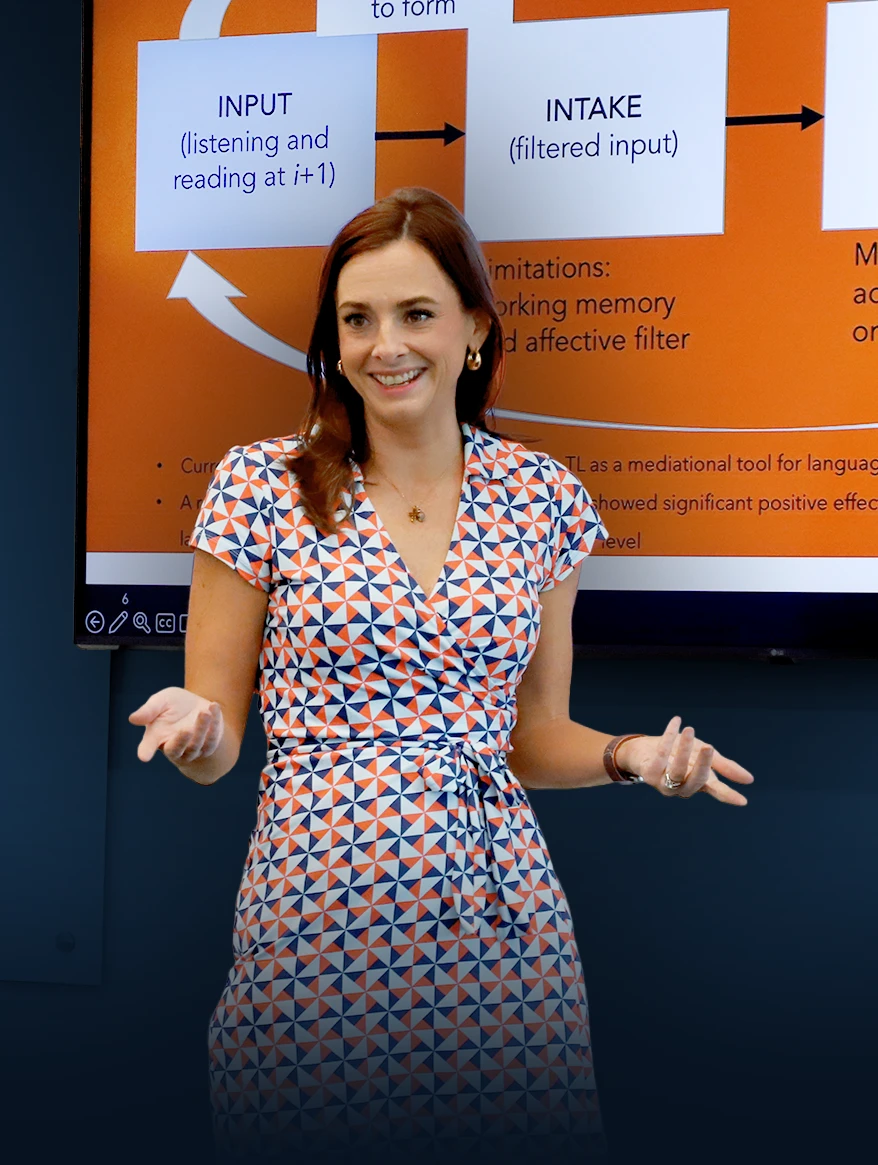
For Megan Burton, a professor of Elementary Education in Auburn’s College of Education, the integration of artificial intelligence into higher education revolves around the concept of collaboration between the teacher and the tool.
A passionate advocate for empowering future educators, Burton is working hard to understand how AI can be a resource for teachers and ways to address the challenges it brings. She has presented at and attended numerous national conferences on AI in education and researches the use of AI by educators. She incorporates lessons learned with teacher candidates in her own teaching.
“Teacher candidates use AI in class as we examine possible activities, questions to ask learners, possible misconceptions, assessments and other ways to meet learners’ needs,” Burton said. “With each of these activities, our teacher candidates analyze, revise and compare the AI outputs with what we are learning about effective teaching and learning.”
Again, Burton emphasizes that AI should be used in conjunction with the skills of her future teachers, all in an effort to create a better learning environment for their students.
“We work on utilizing our professional knowledge and knowledge of our elementary learners to revise and refine prompts for AI and the outputs we receive so that we can best meet the needs of our learners,” she said.
She highlighted AI tools educators should know, from education-specific platforms like Eduaide, Brisk, Kahnmigo, Magic School and Teacher Tool AI to broader tools such as Gemini, Claude and Copilot. She also mentioned more personalized AI tools like Snorkel, Napkin AI and Slides GO as well as Notebook LM. Burton said she hopes teacher candidates in her classes part with the mindset that AI is not a replacement, but a tool that makes them more efficient educators.
“I hope they see it as a tool, similar to curriculum guides and teacher tools that rely on the teacher’s expertise of subject, teaching, pedagogical content knowledge and students in order to effectively use the tools that AI can provide,” she said. “It can save time, but can’t replace the expertise, professional and personal knowledge, and the relationship skills that the teacher brings to the classroom.”
Elementary Education major Brooke Fligel, a student in one of Burton’s classes, said she has enjoyed learning about how AI can support her as a student and as a future teacher.
“Dr. Burton has emphasized how AI can be used as a tool to support our learning, rather than replace our thinking,” Fligel said. “We have explored ways that AI can help us generate questions that assess and deepen understanding, create worksheets or activities for lessons, and support many other instructional tasks. Dr. Burton has shown us meaningful and responsible ways to incorporate AI into our classrooms, and I can’t wait to use it in the future.”
Overall, Burton believes that AI will continue to be a helpful tool in the teaching field, allowing teachers to focus more on the aspects of their job that require a human touch.
“It can help teachers focus their time and energy on the relationships with their learners and the expertise they bring to the classroom that can’t be replaced by AI,” Burton said. “It can also free up time spent on tasks such as creating newsletters, word-smithing, generating general concepts and such, because teachers can then fine-tune and hone the outputs with their expertise.”
Although Burton said she believes AI would never fully replace teachers, she said it can be a valuable tool of support that will likely transform the career of teaching.