

Advancing Innovation & Outreach
Leading the AI Charge
Artificial intelligence is reshaping every corner of education — from how researchers collaborate to how institutions craft policy to how classrooms evolve. At Auburn University’s College of Education, faculty members in the Department of Educational Foundations, Leadership, and Technology are helping define what responsible, forward-thinking AI leadership looks like across the state, region and nation.
Building research communities through Team Science
As a member of Auburn’s growing Team Science Initiative, Associate Professor and Department Head Hank Murrah is helping shape a collaborative research culture that brings AI to the forefront of interdisciplinary inquiry.
Team Science is built on a simple but powerful idea: complex problems demand different perspectives. The initiative “connects experts from different disciplines, backgrounds and perspectives to address research problems with a more comprehensive understanding of complex issues.” By fostering engagement and building connections across campus and beyond, the initiative aims to spark “more innovative, impactful and sustainable outcomes.”
Murrah’s leadership was recently on full display as he and College of Education Associate Professor David Marshall presented on Artificial Intelligence at the AI@AU/Team Science Series: Building Research Communities in AI Showcase and Workshop. The event was part of a new series designed to increase faculty engagement and expand Auburn’s capacity for interdisciplinary AI research teams. As part of their presentation, Murrah and Marshall offered insight about a survey they are planning that will ask deans of research a series of questions about AI use in research. Their goal is to develop a set of guidelines for universities on AI use for research.
For Murrah, the work is about more than technology — it’s centered on building the collaborative infrastructure that allows AI research to thrive. His involvement also intersects with university-wide efforts led by Associate Vice President for Research Jennifer Kerpelman, who is guiding the Team Science initiative.
Shaping campus-wide AI policy and research culture
In addition to building interdisciplinary bridges, Marshall is also helping Auburn navigate the rapidly evolving landscape of AI policy and research practices. As the College of Education’s representative on the Faculty Senate’s Faculty Research Committee — and now in his first year as chair — Marshall is leading conversations about how Auburn can support responsible, innovative AI research across disciplines.
“My charge has been simple — the Biggio Center has done excellent work in taking the lead regarding the use of AI in teaching. We need something similar for research, and the FRC is a good organization to help lead in this way,” Marshall explained.
The committee is still early in its work, but momentum is building. Members have begun reviewing existing campus policies and learning from faculty across Auburn, including a recent presentation from a Forestry, Wildlife, and Environment researcher on how AI is transforming his field. Marshall also collaborates closely with Kerpelman, whose Team Science initiative on AI aligns with his committee’s goals.
“This is a wonderful opportunity to lead on the issue of AI and research, and I’m excited to see what comes of our efforts on the Faculty Research Committee and elsewhere on campus,” Marshall said.
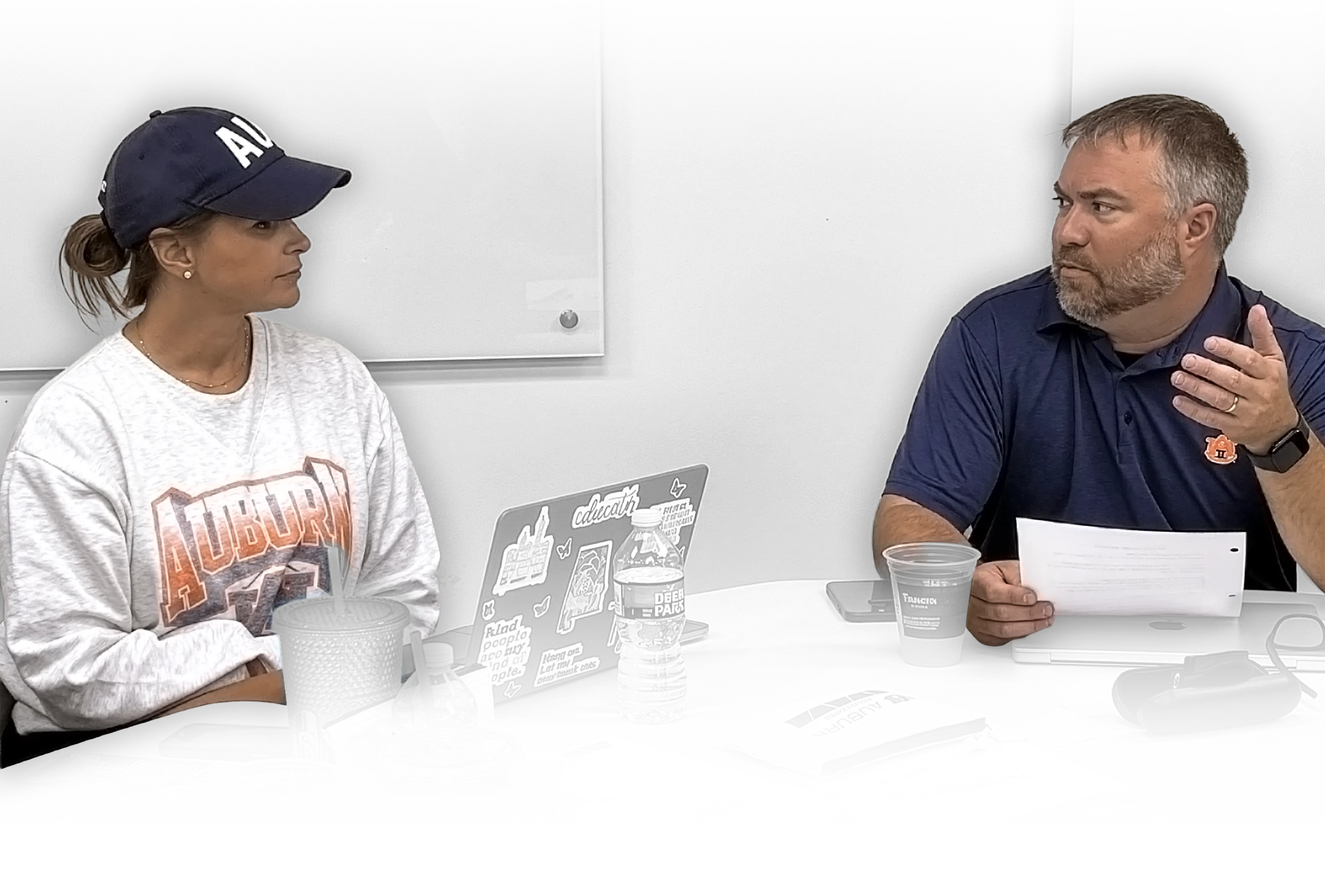
Through the grant, teachers at charter and city schools in Birmingham, Lochapoaka High School, and various schools in Alabama’s Black Belt will receive free licenses for the Biggio Center’s K-12 AI Professional Development course.
“We designed this course to meet teachers where they are — curious, concerned and eager to do right by their students,” Ali said. “This grant allows us to bring high-quality, practical AI training to educators across Alabama, especially in places that are too often left out of the innovation conversation. Our goal is to empower teachers as they navigate this pivotal moment in education.”
In total, Marshall said the grant opens the course to more than 200 Alabama teachers at no cost.
“The grant we received from the Office of Faculty Engagement is allowing us to connect with teachers across the state of Alabama to ensure that they are equipped to teach in the age of AI,” Marshall said. “We believe that it is important that teachers and students alike learn to use these emerging tools in ways that enhance, and not replace, how they teach and learn.”
Also contributing to the effort is recent College of Education EFLT graduate Katelyn Nelson, who now works for the Biggio Center and was asked one year ago to lead the first student M365 Copilot Beta Program in the United States.

Advancing regional and national AI policy guidance
As Murrah and Marshall strengthen Auburn’s internal AI ecosystem, EFLT Associate Professor Amy Serafini is shaping the broader policy landscape through her work with the Southern Regional Education Board (SREB).
Serafini was invited to join SREB’s Commission on Artificial Intelligence in Education, a multi-state effort launched in February 2024, to develop practical, ethical guidance for AI adoption across K-12 and higher education.
“The opportunity came about through SREB’s effort to bring together leaders from across its 16 member states, spanning K-12, postsecondary, workforce agencies, and industry, to develop practical guidance for education systems adopting AI.”
Her role ensures Auburn directly impacts the Commission’s work.
“Through my work with SREB, I advance campus capacity by bringing back actionable resources and policy-ready guidance that Auburn and institutions across the southern region can adapt,” she explained.
These include ethical implementation recommendations and tools such as SREB’s AI procurement, implementation, and evaluation checklist.
The Commission approved 12 recommendations designed to help states and institutions adopt AI responsibly. For higher education, these recommendations translate into concrete operational benefits: structured guidance for different user groups, high quality professional development, stronger procurement and risk management policies, needs assessments, resource allocation plans, and evaluation frameworks to monitor impact. The Commission also calls for postsecondary adoption playbooks — an approach Serafini says aligns perfectly with Auburn’s leadership role.
“Auburn is a leader in the southern region and across the globe in regard to the commission’s recommendations,” she said.
She added that serving on the Commission has been both meaningful and affirming.
“I was honored to serve on the Commission on behalf of Auburn University, whose leadership continues to position the institution as a trailblazer in the field of artificial intelligence.”